
QR Code Statistics 2026: Every Number Sourced
QR codes generate two contradictory headlines at once: consumers say they are tired of them, yet the technology keeps embedding itself deeper into payments, retail, and fraud. This page collects the QR code statistics that actually check out. Every number below is tied to a linked source that we opened and checked, and we re-verify the whole page every quarter. Where the sources disagree, we show you both figures instead of picking the prettier one.
QR codes in 2026: the headline numbers
On HonestQR, 86% of QR code scans happen on mobile devices. QR is a phone-first medium, and our own scan data further down this page reflects that almost completely.
eMarketer forecast that nearly 100 million Americans would scan a QR code in 2025, up from 83.4 million in 2022. That is the clearest growth curve in the consumer data.
People aged 35 to 54 are more likely to interact with QR codes than 18 to 34 year olds, according to GWI's 2024 data. That is the opposite of the youth-first story most QR pages tell.
Coinbase's bouncing QR code drew more than 20 million landing-page hits in one minute during the 2022 Super Bowl and crashed its own app, according to Branch's teardown of the campaign, which quotes Coinbase's chief product officer.
90% of American diners said they prefer paper menus to QR codes in US Foods' 2024 survey, up from 74% in 2023. The pandemic-era menu code has worn out its welcome.
India's UPI network processed 24.51 billion transactions in August 2026, its highest monthly volume so far, according to NPCI data reported by PTI.
India had 731.4 million UPI payment QR codes in place at the end of December 2025, according to the Reserve Bank of India, up from 657.9 million nine months earlier.
QR code payments are forecast to reach 9.17 trillion dollars in 2031, growing about 67% from 2026, according to Juniper Research's August 2026 report.
QR-code email attacks peaked at 18.7 million in March 2026 and then fell for three straight months, to 8.3 million in June, Microsoft Threat Intelligence reported.
UK victims lost almost 3.5 million pounds to fraudulent QR codes across 784 reports between April 2024 and April 2025, according to Action Fraud.
QR code adoption and usage statistics
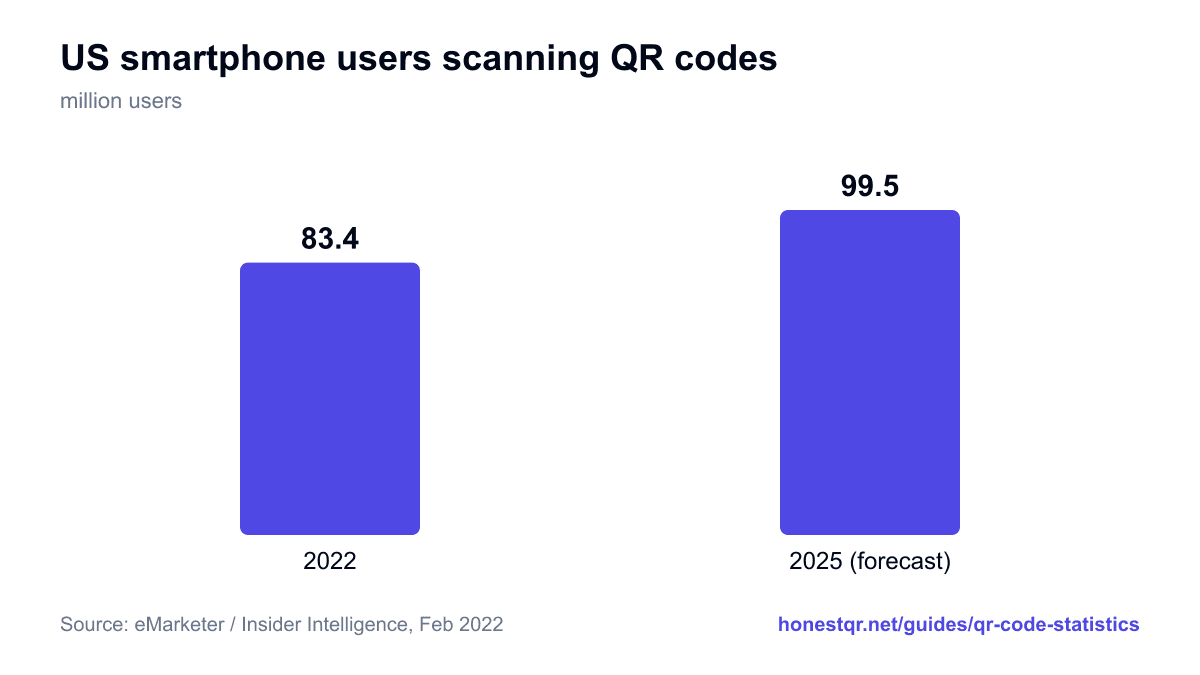
The clearest adoption data comes from the United States. eMarketer's February 2022 forecast put US smartphone users scanning a QR code at 83.4 million in 2022, climbing to a projected 99.5 million by 2025. In share terms, that is 42.6% of US smartphone users scanning at least one code by 2025, on an 8.7% compound annual growth rate from 2020. These are forecasts made in 2022 for years that have now passed. eMarketer has not published a free update, so we show them as what they are.
The numbers are not perfectly clean, and we will not pretend otherwise. A later industry estimate quoted in a US Census Bureau working paper put US QR scanners at 89 million in 2022, up 26% compared with 2020, which sits well above eMarketer's 83.4 million forecast for the same year. Both figures are in the table below. When sources this credible disagree, the honest move is to show the range, not average it into false precision.
The demographic picture is the real surprise. GWI's 2024 data, summarized by DataReportal, found that people aged 35 to 54 are more likely to interact with QR codes than 18 to 34 year olds. QR scanning skews slightly older than the youth-first cliche suggests, which matters if you are deciding where to place a code.
| Statistic | Value | Year | Source |
|---|---|---|---|
| US smartphone users scanning QR codes (2022 forecast) | 83.4 million | 2022 | https://www.emarketer.com/content/qr-codes-forecast-trends-2022 |
| US QR scanners (2022 forecast) | 99.5 million | 2025 | https://www.emarketer.com/content/qr-codes-forecast-trends-2022 |
| Share of US smartphone users scanning (2022 forecast) | 42.6% | 2025 | https://www.mediapost.com/publications/article/371193/834-million-us-smartphone-users-will-scan-qr-co.html |
| US scanners (later industry estimate) | 89 million, up 26% on 2020 | 2022 | https://www2.census.gov/library/working-papers/2024/adrm/cbsm/rsm2024-05.pdf |
| 35 to 54 year olds compared with 18 to 34 | More likely to interact with QR codes | 2024 | https://datareportal.com/reports/digital-2024-october-global-statshot |
QR code payment statistics
If consumer novelty is cooling, payments are where QR became infrastructure. Juniper Research's August 2026 report forecasts the value of QR code payments at 9.17 trillion dollars in 2031, about 67% more than in 2026.
India is the clearest example. Its UPI network processed 24.51 billion transactions in August 2026, the highest monthly volume so far, per NPCI data reported by PTI. By value, the record is May 2026, at about 312 billion dollars, a level matched in rupee terms in July. The Reserve Bank of India counted 731.4 million UPI payment QR codes in place at the end of December 2025, up from 657.9 million at the end of March 2025. The IMF has assessed UPI as the world's largest retail fast-payment system by transaction volume.
China is the other giant. Online payment users there stood at 1.017 billion in December 2025, according to CNNIC, slightly below the year before. Chinese mobile payment is overwhelmingly QR-led, so treat that as a proxy for QR reach rather than a direct count of QR users.
One number to handle with care: Juniper's forecast that global QR payment users would exceed 2.2 billion. That is a 2021 forecast for 2025, not a measured headcount, and figures this large are always projections. We keep it because it is still the most-cited global user estimate, but we label it as the forecast it is.
QR codes in marketing: what the honest data shows
QR marketing has a boom-and-backlash shape, and both halves are true.
The boom peaked at the 2022 Super Bowl, when Coinbase ran an ad of nothing but a bouncing QR code. It drew more than 20 million landing-page hits in a minute and crashed the Coinbase app under the load. MediaPost reported the spend at about 14 million dollars, an outside estimate based on prevailing ad rates. It became the case study everyone cited for QR's arrival.
The backlash is just as measurable. In connected-TV advertising, QR scan rates fell from 0.010% in the first half of 2025 to 0.004% in the fourth quarter, per EMARKETER data provided by BrightLine. The interest is there in principle: a Sharethrough survey of 1,000 people in the US and Canada, reported in January 2022, found 76% would scan a QR code in a relevant TV ad and 79% already use their phone during ad breaks. Turning that intent into actual scans is the hard part.
The menu is where the fatigue shows most. US Foods' April 2024 survey of 1,005 Americans found 90% prefer paper menus, up from 74% in 2023. The generational detail defies expectations: 90% of Gen Z prefer paper, up from 69%, and 95% of Boomers, up from 86%. For contrast, Datassential's 2021 to 2022 data, reported by The Food Institute, had 68% of Gen Z saying they had used a QR code to pull up a restaurant menu, against 22% of Boomers. Different measure, earlier moment: together they show a real reversal in menu behavior, not a contradiction.
Structural adoption, though, keeps moving the other way. Under GS1's Sunrise 2027 initiative, retailers and brands are migrating product barcodes from one-dimensional UPC symbols to two-dimensional formats that include QR. Sunrise 2027 is a target date and an industry milestone, not a legal mandate, so treat any coverage that calls it a requirement with suspicion.
QR code security: quishing statistics
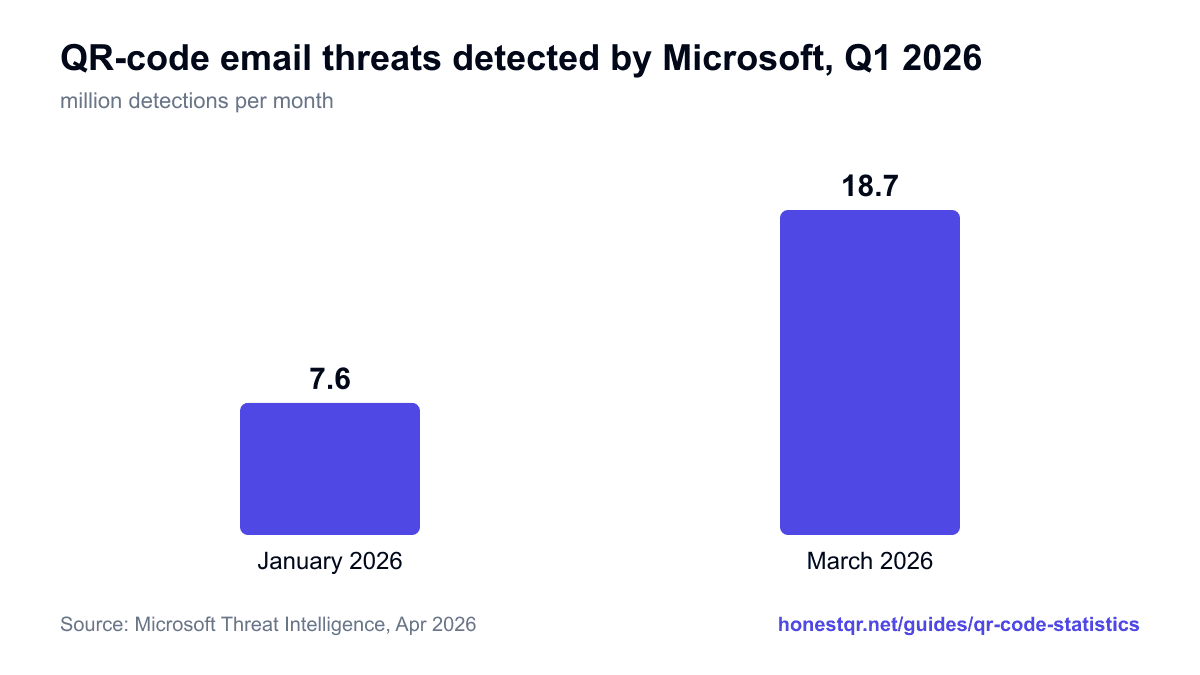
The QR abuse numbers moved fast in 2026, in both directions. Microsoft Threat Intelligence called QR-code phishing, or quishing, the fastest-growing email attack vector of the first quarter, with detections up 146% from 7.6 million in January to 18.7 million in March. Then it reversed: Microsoft's second-quarter report shows three straight monthly declines, to 17.4 million in April and 8.3 million in June, back to levels last seen in mid-2025. Most of it hides in attachments. PDF files carried 65% to 70% of these QR attacks in the first quarter and peaked at 79% in April before falling to 58% in June. QR codes embedded directly in email bodies, which surged in March, had all but disappeared by the second quarter.
The targeting is deliberate. In February 2024, Abnormal Security reported that C-suite executives were 42 times more likely to receive a QR phishing attack than non-executive employees, and that 89.3% of QR-code attacks were credential phishing aimed at stealing logins. Palo Alto Networks' Unit 42 reported more than 11,000 malicious QR detections per day in February 2026, with roughly 15% of QR-bearing pages leading to malicious links. Unit 42 also tracked traffic to QR code shortener services rising 55% from the first half of 2023 to the first half of 2024, then another 44% the following year, as attackers use shorteners to mask their destinations.
The losses are real. In the UK, Action Fraud logged 784 quishing reports and almost 3.5 million pounds in losses between April 2024 and April 2025. In the US, the FBI's IC3 issued a public alert in July 2025 about scams using QR codes in unsolicited packages. The practical defense has not changed: check where a code actually points before you enter credentials or payment details, and be suspicious of stickers placed over printed codes.
What our own platform data shows
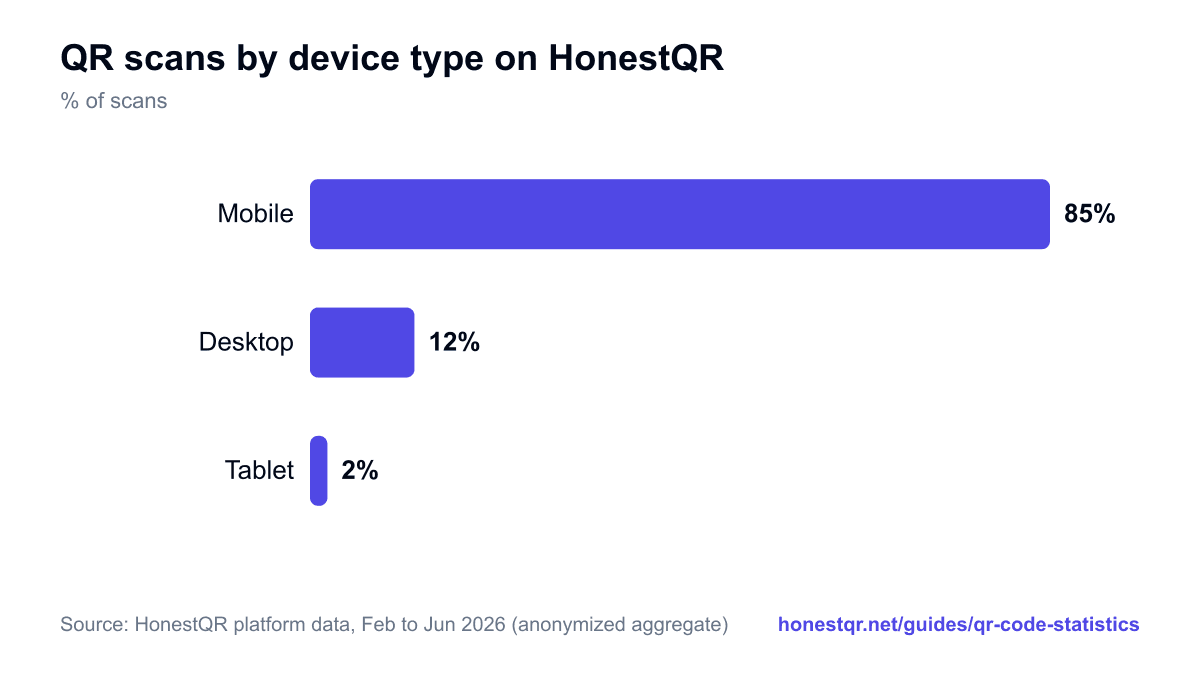
We run a QR platform, so we can add one honest first-party datapoint instead of recycling someone else's. These figures come from anonymized, aggregated scan events on HonestQR between February and September 2026, published as percentages only.
Scanning is overwhelmingly a phone activity. Mobile devices account for 86% of scans on HonestQR, desktop for 12%, and tablets for 2%. Those scans came from 56 countries, which lines up with QR being a global, phone-first medium rather than a regional one. Because these scans run through dynamic QR codes, the redirect keeps logging long after the artwork is printed.
We publish shares by design. Raw scan and code counts would be a vanity metric and would tell you nothing useful, so this page keeps to percentages. Our QR codes that don't expire mean the scan record accumulates over years, not weeks, and you can make a static code at no cost with our free QR code generator, or a trackable dynamic one on a paid plan.
iOS vs Android: what we see
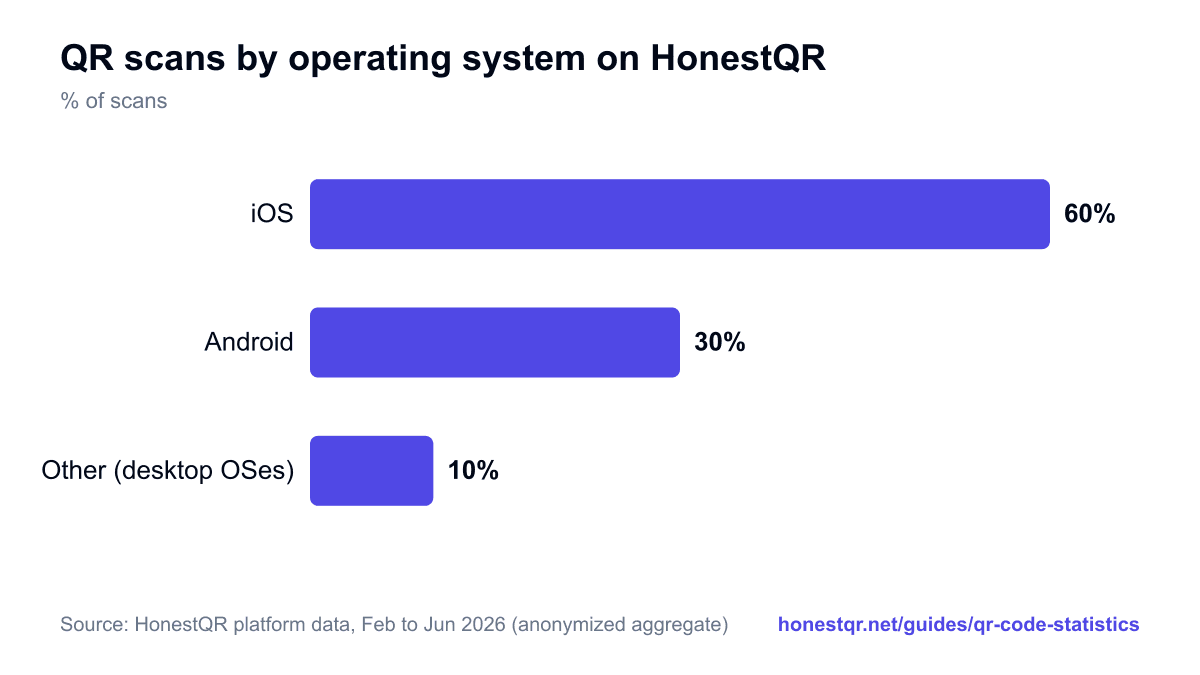
Break the same scans down by operating system and iOS leads: about 59% of scans on HonestQR come from iOS, 31% from Android, and the remaining 10% or so from desktop operating systems. Roughly six in ten scans land on an iPhone or iPad.
We flag one honest gap here. There is no credible third-party source for how iOS and Android users differ in QR scanning behavior. The platform splits quoted around the web do not trace to a real study. So we offer our own split as the only sourced datapoint we know of on the question, with the caveat that it reflects traffic across codes made on HonestQR, not the whole internet. If you see a confident global iOS-versus-Android scanning statistic elsewhere, ask where the underlying data actually came from.
QR code market size forecasts
Market-sizing reports are the least reliable QR statistics, because every firm draws its boundaries differently, so we present them as a labeled range rather than a single truth. Read every row below as a vendor forecast.
The three reports that size QR codes or QR payments put their base years between about 13 and 18.6 billion dollars. Two of them project growth of roughly 16.5% to 17% a year, and one, the clear outlier, projects 36%. The labels market is a separate, smaller category growing more slowly. Take the spread, not any single headline, as the honest summary: nobody actually knows the number to two decimal places, however precisely these reports quote it.
| Report | Base value / year | Forecast value / year | CAGR | Source |
|---|---|---|---|---|
| QR codes market (Mordor Intelligence) | USD 13.04B (2025) | USD 33.14B (2031) | 16.82% | https://www.mordorintelligence.com/industry-reports/qr-codes-market |
| QR payment market (Future Market Insights) | USD 18.6B (2026) | USD 85.6B (2036) | 16.50% | https://www.futuremarketinsights.com/reports/qr-code-payment-market |
| QR payment technologies (Data Bridge, outlier) | USD 15.35B (2024) | USD 179.81B (2032) | 36.01% | https://www.databridgemarketresearch.com/reports/global-quick-response-qr-code-payment-technologies-market |
| QR code labels market (Future Market Insights) | USD 1.8B (2025) | USD 4.1B (2035) | 8.7% | https://www.futuremarketinsights.com/reports/qr-code-labels-market |
Where QR codes came from
The QR code is not new. Denso Wave, then a division of the Japanese company Denso, released it in 1994, with development led by engineer Masahiro Hara. Users of the barcodes of the time wanted a code that held more information, and the design goal was one that could also be read quickly from any angle. The auto industry adopted it early for its electronic Kanban, long before it reached menus, packaging, and payment terminals. Denso Wave keeps a short official history at https://www.qrcode.com/en/history/.
Methodology: how these statistics were verified
Every statistic on this page was verified the same way. We open each source URL, confirm the number appears on the page we link, and grade it: A for primary or authoritative sources, B for reputable secondary sources and carriers, and C for vendor marketing, which we label wherever we use it. Each section ends with a table that links the sources for its figures. Where the original publisher's page is public we link it; where it is not, we link the carrier we read and name the original source in the text. Anything we could not confirm on a live page is left off, however tempting the number.
This page was last verified on 3 October 2026, and we re-verify the whole thing quarterly: every statistic is re-checked against its source, dead links get replaced or removed, and the last-verified date moves with each pass. To cite it, use: HonestQR QR Code Statistics, honestqr.net/guides/qr-code-statistics.
What changed in the October 2026 pass. Microsoft's second-quarter report reversed the security story, so the quishing section now shows the fall as well as the surge. Juniper published a new edition of its payments forecast, the Reserve Bank of India and CNNIC published newer counts, and UPI set a new monthly volume record, so those figures were replaced. We removed one market forecast, Grand View Research's, because its page would not open for us and we do not list numbers we cannot see. We also corrected our own wording in several places where it said more than the source did, including the 26% rise in US scanners, which is measured against 2020 and not year on year.
We show source conflicts rather than hiding them. eMarketer forecast 83.4 million US scanners for 2022 while a later industry estimate put the figure at 89 million, and we list both. Juniper's 2022 report forecast 3 trillion dollars in QR payment value for 2025, its 2025 report put that year at 5.4 trillion and 2029 above 8 trillion, and its 2026 report now forecasts 9.17 trillion for 2031. We cite the newest edition and note the revisions.
We also decline stats that do not hold up, which is most of the traffic in QR listicles. We do not publish the widely-copied claim that a Pew Research survey found 87% of 18 to 29 year olds have scanned a QR code, because Pew ran no such survey and the citation is fabricated across dozens of pages. We drop the recycled growth claims (the 89% growth from 2018 to 2020 figure and its 400% cousins) that trace only to other listicles, MobileIron's 86.66% scanned figure whose original report is dead, Egress's claim that 12% of phishing contains a QR code whose source page no longer resolves, and the various TV-scan-rate claims attributed to firms like TiVo and Nielsen that appear only in search snippets with no fetchable page behind them. If a number matters and we cannot stand behind its source, it is not here.
Frequently Asked Questions
What percentage of people scan QR codes?
In the US, eMarketer forecast in 2022 that 42.6% of smartphone users would scan a QR code by 2025, up from 83.4 million users in 2022. Globally there is no single credible figure, but GWI's 2024 data shows people aged 35 to 54 are more likely to interact with QR codes than 18 to 34 year olds.
How many people use QR codes in 2026?
There is no measured count for 2026. The most recent public figures are forecasts made for 2025: eMarketer's 99.5 million US smartphone users scanning QR codes, and Juniper Research's 2.2 billion QR payment users globally. Numbers this large are projections rather than counts, which is why this page ties every figure to a linked source.
Are QR codes growing or dying?
Both stories are true in different places. Consumer-facing novelty uses have cooled: 90% of US diners preferred paper menus in a 2024 survey, and QR scan rates in TV ads fell during 2025. But QR as infrastructure keeps growing: India had 731.4 million UPI payment QR codes in place at the end of 2025, global QR payment value is forecast to reach 9.17 trillion dollars in 2031, and retail barcodes are migrating to 2D codes under GS1's Sunrise 2027 initiative.
Are QR codes safe to scan?
Mostly, but QR phishing (quishing) is real and volatile: Microsoft measured QR-code email attacks peaking at 18.7 million in March 2026 before falling to 8.3 million in June, and UK victims reported almost 3.5 million pounds in losses in the year to April 2025. Check where a code points before entering credentials or payment details, and be wary of stickers placed over printed codes.
What is the average QR code scan rate?
Honest answer: credible public benchmarks are scarce. Most 'average scan rate' numbers circulating online do not trace to a real source, so we do not publish them. The verified datapoints that exist are context-specific, like CTV ad scan rates of 0.004% to 0.010% in 2025. For your own campaigns, dynamic QR codes with scan tracking give you real numbers instead of industry guesses.
How often is this page updated?
Quarterly. Every statistic is re-verified against its source, dead sources get replaced or removed, and the last-verified date in the methodology section is updated. Statistics we cannot verify do not appear here.
Ready to create your QR code?
Free static QR codes with a free account. Go dynamic with scan tracking and a 7-day free trial.